
Updated 5/11/2025 to include a new resource for nonprofits that is the equivalent of outsourcing volunteers!
As a small business owner or a solopreneur, you will need help to grow your business. I have spent 10 years making mistakes and finding success in growing a team. This article walks you through the mistakes we made, adjustments we made, and what you need to do to be successful in small business outsourcing.
When Brian Washburn and I started Endurance Learning in 2015, I started full time on building the new company while Brian was still working a full time job. I was the staff muscle. I did every job and filled out every piece of paperwork. For the first couple of years we didn’t need much help from outside resources. We just needed customers! It felt like we were working hard every hour we were awake.
When we dreamed about growing our business, we talked about full-time staff. That was what we had grown up in and the way we thought organizations grew. We proceeded to add a first full time staff person and eventually grew to as many as 7 staff people. The best part of this was that this team was heavily made up of women who have proven to be more interested in the flexibility that remote work provides.
“86% of women prioritize flexibility over career advancement.” – Mark Shorb, Founders Report
We now use a great mix of full time employees, full time contractors, part-time contractors and gig workers.
Don’t be afraid to fail
Your scaling strategy should involve reducing risks and maximizing the benefits. I’m sharing my experiences here to help you. Each of my recommendations comes from a mix of experimentation, mistakes and successes.
Early in our own business we were working with a contractor to do layout.
Before hiring, I had to pause and figure out where my biggest bottlenecks were. What was draining our time but didn’t need my specific touch? What was holding back growth?
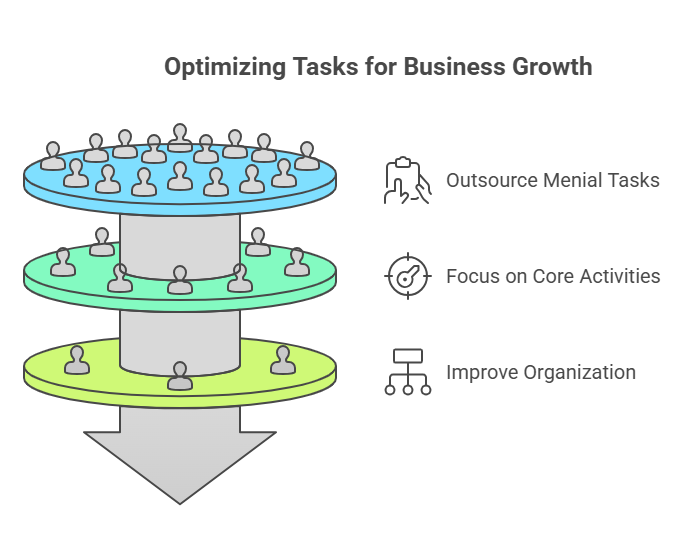
I’m a big fan of the book Buy Back Your Time by Dan Martell. His core message really stuck with me: don’t hire to offload work; hire to reclaim time you can reinvest in higher-value activities. Martell describes it as a ladder where the bottom rungs represent the lowest value work. For him the examples were scheduling meetings and sending emails.
Why do small businesses hesitate to outsource?
One challenge that I have and I’ve seen in many clients is that they find comfort in the work at the bottom of the ladder. Do any of these sound like you?
- A donor relations professional for a nonprofit who has a natural talent for engaging people and building relationships chooses to sit on the couch at night and do data entry.
- A CEO told me that he really enjoys editing every blog post the team writes even though the team is phenomenal at writing these.
- A visual designer who has a knack for understanding customers’ visual design needs loves turning on music and doing data entry for print material layout.
All of these examples are fine in isolation and I’m certainly not judging. I love to talk about my work optimizing our company processes using Zapier, AirTable, OpenAI, etc. but I’m careful not to talk about the specific hours these projects take because I know that many of them should be outsources to someone else once I figure out the concept.
This gets me to the excuses. Again, these are reasons I hear regularly.
- “It would take me longer to explain to someone else what I need than to do it myself.”
- “I can’t trust someone else to do this. It is too important.”
“Until you record where your time goes, you’re working off assumptions.”
— Peter Drucker
In The Effective Executive, Peter Drucker advised every leader to track their time in 15-minute increments for two weeks. Why? Because leaders routinely overestimate how much time they spend on strategic work and underestimate how much is lost to things others could do. I’ve tried this, and it’s humbling.
If you want to scale, this kind of time audit is invaluable. You can’t outsource wisely until you know where your time is really going.
The reality is that by taking on these tasks at the bottom of the ladder, leaders are reducing the time that they can focus on building they business they want.
Tasks That Are Easy to Outsource, Delegate, or Automate
When you think about the work you should outsource to grow a small business, think first about work that is lowest on that ladder. What menial tasks could you get someone else to do if you had time to onboard them? Whether you love those tasks or hate them, the goal is to free up your time (or buy back your time according to Martell) so that you can focus on work that will improve your organization.
Administrative & Scheduling
- Calendar management and appointment setting: Think about how much time you spend going back and forth with prospects, partners, etc. to coordinate times.
- Inbox triage or replying to common emails: This is a tricky one. Do you get all support emails in your inbox? What would it look like if you could create a second email for most inquiries? What would it look like if someone else addressed 9 out of 10 emails?
- Travel booking: If you travel for your consulting on any kind of regular basis consider empowering someone else to do this work for you.
- Event planning: If you regularly run events, chances are that you take on too much of this work.
Marketing & Content
- Formatting and posting blogs or newsletters: You saw my example above about the CEO who loved editing each article. Is this necessary? Can others take on this work?
- Creating and scheduling social media posts: Once someone knows your voice, let them do the heavy lifting. Social media can be both very important and a huge waste of your time.
- Editing podcast episodes or videos: There are no shortage of people who will help with this. Even with the best modern tools, it still takes time.
- Repurposing content (e.g., turning blog posts into LinkedIn threads): You wrote it once! Now let someone else figure out how to get more value out of it.
Operations
- Updating CRM records and tagging contacts: Nobody in any company likes updating a CRM. My guess is that most small business owners either don’t have a CRM or choose to ignore it. In any case, this work should be done by someone else.
- Formatting proposals or pitch decks: I have been quite guilty on this one in the past. I’ll write more in the future about how to better manage proposals.
- Following up on unpaid invoices
- Bookkeeping: It is easy to believe that you should do this yourself because QuickBooks and Xero make such quick work of it. Don’t ignore the time it takes.

There are many other possibilities. The best way to identify what is best work for you to hand off is to audit your own work.
What strategies will lead to success?
Small business outsourcing is about picking the right approach to each business challenge.
Hire Specialists
I am a jack-of-all-trades. I love to take on different kinds of work and solve different problems. In the past, I have made the mistake of hiring more Jacks- or Jills-of-all-trades. When you run a small business you know that staff will have to contribute in multiple ways. You don’t want to hire a full-time person and then be stifled by their inability to contribute in multiple areas. That’s where a mix of approaches is critical.
A study published in the Journal of Occupational Health Psychology found that high-performance work practices (HPWPs) have a strong negative relationship with burnout, suggesting that aligning work with employees’ specialized skills can enhance quality and reduce burnout.
You can choose to only have full time staff and hope to have enough work for them in their expertise or settle for lower productivity and effectiveness and have them cover multiple areas. Neither is wrong, but both come with risks. Supplementing yourself or your staff with a mix of contractors who specialize in an area of work can reduce this risk. Whether it’s a designer who knows branding inside and out or a VA who excels at CRM management, specialists move faster and produce better results.
When someone loves and lives their craft, you get efficiency, insight, and quality. You also spend less time training and more time getting value from their work.
Fish in a Bigger Pond
I see this issue most clearly in small nonprofits. They tend to hire from their community first. I’ve heard that they trust this person because they already buy into the mission or understand the culture and history of the organization. How could we possibly get someone else up to speed.
I get this logic and recognize that it has value. That said, this generally leads to hiring someone who is just not as good as they could be. Think of it this way. I tell you that you can hire anyone you want for your marketing role but they have to live within walking distance of your office. That would feel pretty restrictive, right? Hiring from people you know who are available is the same approach.
Using services like Work Better Now and Upwork gave me access to skilled people who need work and are ready to support my small business. They still require onboarding and support, but I’m definitely fishing in a much bigger pond.
Prepare to Onboard New People
I get nervous adding this to the list because I have seen people get stuck on this step and never take action. There are two directions that I see this fail.
- A small business owner hires a resource to do a job and doesn’t have much information defined or a clear scope for the job. The CEO or owner wasn’t ready to hire someone but knew they needed to. The experience reinforces that belief that they need to do the work themselves and that hiring someone is a waste of time and money. The reality is that they aren’t setting the person up for success.
- The owner is aware that they’ll need to train someone and just can’t find time to write down everything they know. If they had this kind of time they wouldn’t need to hire someone! So, they procrastinate and eventually do it themselves. It is a never-ending cycle.
It has never been easier to break this cycle. Here’s my method. You can learn more about the logic behind my documentation approach in the article on documenting for retrieval.
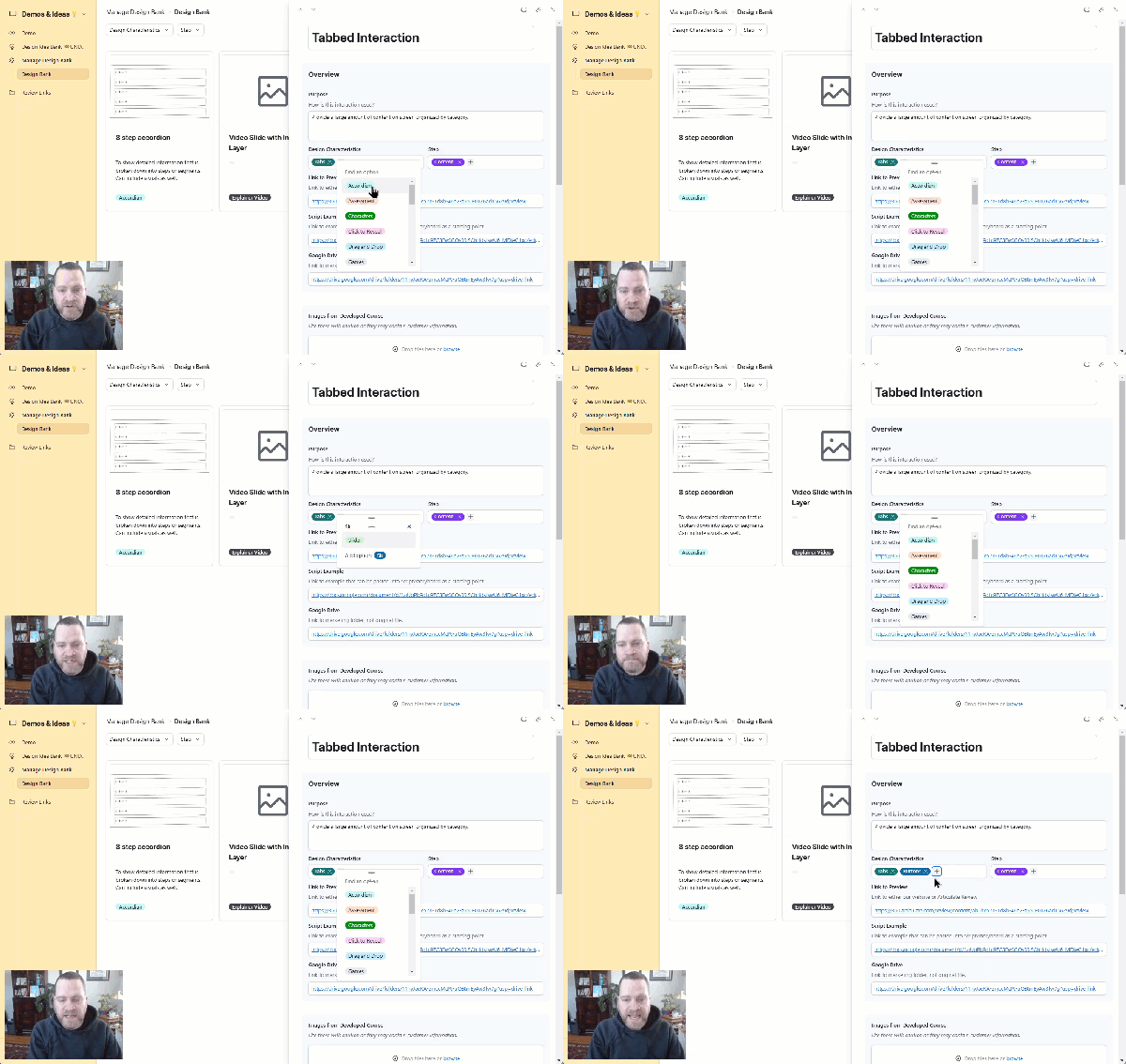
- Spend 30 minutes writing a clear list of tasks. This doesn’t have to be perfect or in the right order. But you need to create the list of potential tasks.
- Pick the task that is most urgent and record a video of how to do it. This will look different depending on the type of work, but for most of the types of tasks we’re talking about it probably involves sharing your screen and recording what you do. I do this using SnagIt. I’ve used it for at least 20 years because it is reliable.
- Share this with the person doing the work and have them review this before you meet with them. Then your meeting can be focused on answer questions and solving problems. If they haven’t reviewed it or didn’t get it, you may need to consider whether this is the right person.
Hire from the Right Pool
This has taken me time to find a mix of outsourcing approaches. Our small business uses all of these at one time. Don’t let someone tell you that one approach is better than another.
Deciding who to hire
Hire Employees (W2)
The idea is that you hire anywhere between a part-time and full-time person that is part of your team. When we first wanted to expand Endurance Learning we felt strongly that we needed to add staff. We knew that we would have a hard time finding an experienced instructional designer to join our team because we were a couple of people with a vision and a few customers. We had no processes and few systems yet. We put a fun ad out on LinkedIn that looked like the original Shackleton ad for his crew (Endurance Learning was named after his ship after all) and relied on our network to help us find the right person.

We were quite lucky with our first hire. She joined our team and immediately fit in what we liked to call the 3 part Venn Diagram. She served our customers incredibly well and added great value to our team. Within a year after that we felt that we needed to grow to handle an increase in work and control quality. We chose to hire again. We were successful the first time, right? We put out another add (the one shown) and were excited to get some really interesting candidates. We hired our second employee and felt like we were on the right track.
Within six months, we all knew that it wasn’t the right fit. We hired someone who really wanted to be a contractor and not an employee. We were paying someone full time who wasn’t really engaged with the work in that way. The work was always insanely good but we weren’t getting the benefits of an employee. It was more like having a contractor on retainer. We learned that we need to step back and think about what we needed and whether the person we were talking with was a fit for that role.
- Advantages: Having a full-time employee offers stability and deeper commitment. We saw this with our first employee and it paid off on a regular basis. It’s great for roles that are central to your business and require long-term alignment. You get the potential for higher loyalty and better cultural fit and full integration into your team.
- Risks: As with our second employee, there’s always the risk that you don’t get a good fit. Hiring an employee is generally more expensive and you will probably need to ensure that you have payroll set up correctly and even consider benefits. The bigger risk is that your work slows down and you have to lay off one or more employees. While you may be fine doing this, just know that it can have an impact on other employees’ morale.
- Best for: Hiring and employee is ideal for core roles that you’ll rely on daily. If you are going to hire someone, my recommendation is you do it with the idea that they take ownership of the operation of a certain area of the business. Be careful to avoid hiring people who want to be cogs in a machine. This isn’t realistic in most small businesses. Employees need to be driven to contribute to the business without constant guidance.
TIP: Start with contractors (discussed below) and work toward employees. In our first 10 years we only hired 2 people through a traditional interview process. Everyone else has come to us as a contractor first. This made it easier for us to find out who we really wanted to work with and whether they really wanted to work with us.
U.S.-Based Contractors (1099)
In the early days, I relied on trusted contractors who were often people we already knew through our network. You’ve certainly heard both positive and negative stories about using contractors (1099s) in the media. Companies like Uber have built their entire business on this model.
Our team has consistently used contractors to scale. Where we find it most beneficial is when we have a defined project that requires someone to contribute their skillset. Contract elearning developers have been critical to Endurance Learning’s growth. Even though we had developers on staff, using contractors allowed us to quickly scale. This role is perfect for contracting because we are able to find many people with this skillset, onboard them into our way of working, and then hand them clear requirements for development.
- Advantages: It is an easier commitment to hire contractors. You can also scale them up specifically for projects. You also don’t pay them when you don’t have work for them.
- Risks: Contractors are focused on their specific deliverable and not necessarily the bigger picture. It also isn’t uncommon for them to realize they have other priorities that are more important or to get their dream job and decide to move on from consulting. You also can’t manage them like employees.
- Best for: Specialized tasks, project-based work, and timebound tasks. Remember, they need direction and aren’t walking embodiments of your strategy and mission.
TIP: One key tip from our experience is that you should regularly build a bench of people who can be contractors. You can think of this as networking or mini-interviews. If you don’t do this in advance you’ll have a hard time finding good people once you have an urgent need. Having five people to call on who can do a particular type of work will help ensure that you have one good person ready to go.
Offshore Talent (Full-Time or Part-Time)
For a long time I had a very negative view of offshoring work. In the early 2000’s I was working on a learning and development project that the executive team decided to move to less expensive resources offshore. We spent so much time explaining what we had learned and how we approached the project that it was hard to understand how it was going to be successful. The new team needed a lot more direction. It took me many years to see it from a different perspective.
We had a few roles that we really wanted to add full-time support for but just couldn’t find good fits. had been intrigued by companies that managed virtual assistants (VAs), especially after reading Martell’s book. I had researched multiple companies and always felt skeptical that we could get full use out of their services. I
When I learned about WorkBetterNow on a podcast, I was intrigued. WorkBetterNow walked us through the following intriguing benefits:
- Their staff are in US time zones (we have worked outside our time zones but this is harder).
- They are paid fairly (we aren’t looking to make someone work in poverty just to make us successful).
- We were not locked into a contract with a VA.
I set up a call and was stunned by the process and how much it protected us. We didn’t invest in a VA but used it to help us with two different roles. We’ve had some ups and downs on the hires we’ve made, but our biggest success has been integrating a virtual employee from Latin America into our everyday operations. We don’t use her as a VA at all. She plays a critical role in our day to day process of developing elearning and we fully expect her to be part of the team for a long time.
- Advantages: It is incredible to have a cost-effective, talented, consistent help
- Risks: Time zone and communication take adjustment
- Best for: Be clear with expectations, use Loom to train, manage with tools like Slack and ClickUp
Freelance Marketplaces (Fiverr & Upwork)
A great way to find experts and specialists is to work through freelance marketplaces. You can find almost any skillset and contract for any range of work, from a simple $5 gig (though these are rare now) through a full time contractor.
Fiverr.com
We stumbled on Fiverr.com early in our growth because there was work we just couldn’t do. When a customer asked our team to develop elearning in five languages, we were forced to quickly find a way to hire translators and voiceover artists.
Fiverr was truly designed as a gig marketplace. Base gigs were originally $5. Like any hires, we found that while the cost was generally inexpensive, the quality was a mixed bag. We forced ourselves to be patient. Because the cost was so low, we sometimes tried two different resources on Fiverr at the same time so that we didn’t delay a project.
More importantly, we learned that there was real value in tracking who we worked with and liked. We now have translators that we have probably used hundreds of times.
The chart below shows our own tracking database in AirTable for each of the languages. These are all resources that we have worked with multiple times and trust to do work in these languages. The chart has expanded as we do additional projects. The vast majority of these resources are through Fiverr.
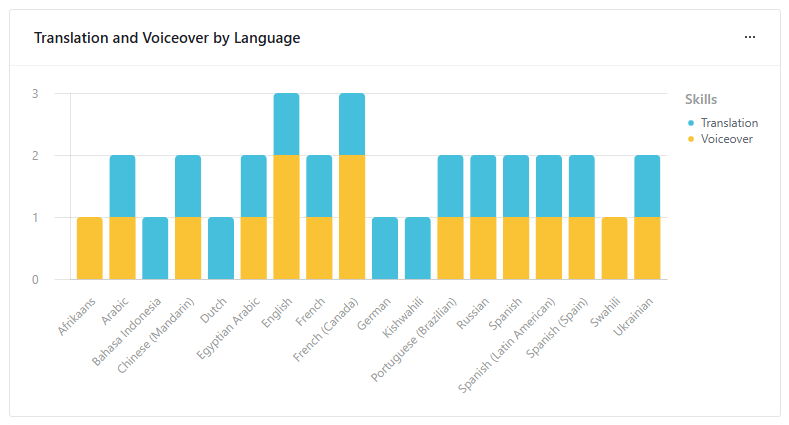
While Fiverr is transactional by nature, building relationships and trust is still realistic and leads to better results. We’ve used Fiverr for:
- Translations in dozens of languages
- Voiceover in dozens of languages
- Graphic design, especially in unique styles like 3D
If you are considering more than testing out Fiverr, check out this Fiverr review.
Upwork
Upwork’s Future Workforce Report 2022 indicates that 60% of hiring managers plan to hire freelancers to manage specific tasks, highlighting a growing preference for specialized skills.
Upwork is a little different. While Upwork can be used like Fiverr, we’ve found it better to hire what would normally be considered part-time roles. Upwork provides the time tracking tools with regular screen captures to show that they are working. While we don’t generally need these, it is nice to know that there is accountability built in. While with Fiverr we generally check for availability and then quickly purchase a gig, with Upwork, we find the contractors to be more relationship based.
We’ve been testing a longer-term engagement on Upwork with a finance specialist. We’ve struggled to find a great fit for this role because we need someone who is willing to learn multiple systems outside of Xero (our chosen accounting tool) and is willing to work with us in the long term.
If you’re using Upwork to find the cheapest resource, just be aware that your resource may be located somewhere 12 hours ahead of you. While some contractors say they’ll work US Eastern time zone hours, I have never felt comfortable asking for this.
- Advantages: Fast, affordable, scalable
- Risks: It is on you to vet contractors carefully. Using the filters for the amount of money they’ve earned and looking closely at completed jobs and reviews is a great start. If it is a bigger job or ongoing, set up a call to talk to the contractors directly.
- Best for: A wide range of tasks and a wide range of commitments.
TIP: Find people who do great work and return to them often. If you treat them with respect and pay them well, they will go above and beyond for you.
Editorial Services
There was a time when we used internal staff for copy editing. We took great pride in the work they did. What we eventually realized was that they weren’t as specialized in this as we wanted them to be. When we were rushed the work wasn’t as good. When one of the people who did this work was on vacation, the work suffered.
In 2023 we switched to outsourced editorial. We were reluctant to work with a firm that didn’t give us the opportunity to build a relationship with an editor. There are a ton of services out there, but our impression was that most of them are using AI to do most of the work. We found great personal relationship with two vendors:
- EditorNinja: There is no question this company is run by real people who invest their talents in your content. We loved our interactions with them and loved that we could work with one editor. Ultimately we decided against working with EditorNinja because we wanted to make sure we sometimes deal in very high volume and need quick turnaround we can rely on.
- Scribendi: The editors at Scribendi are not as visible. While you can request editors you’ve done work with (by code) you won’t be having conversations with them. But I can assure you that these are real people who will not only copyedit and proofread your work but will make suggestions. With each job you submit the document, any style guides and select a timeline (longer is cheaper). We ended up choosing Scribendi and fell in love with the service. We develop large elearning projects and need content to be as high quality as possible in the script form so that we save time and money later in the process.

A Hidden Gem for Nonprofits and Founders: Catchafire
I recently learned about Catchafire through Sasha Zatyrka, the founder of AHSAS School, who is using it to help launch her new school for underserved communities. It’s a platform I wish more small business founders—especially nonprofit leaders—knew about.
Catchafire connects skilled volunteers with mission-driven organizations. Think of it like Upwork, but instead of paying contractors, you’re matched with professionals who want to donate their time and expertise to causes they care about. These aren’t just basic admin helpers, either. Catchafire offers access to graphic designers, grant writers, website developers, financial consultants, HR experts, and more, all ready to take on project-based work.
What impressed me most is how well it aligns with the small business outsourcing challenge: when you desperately need high-level help, but can’t yet afford to pay full market rates. For early-stage organizations or lean nonprofits, Catchafire fills that gap. It also helps nonprofits think beyond their local geography. This is one of the biggest challenges small nonprofits face. Finding
If you’re launching a nonprofit, social enterprise, or purpose-driven startup, this is one of the most overlooked ways to scale your impact without draining your budget.
Catchafire may be free for many nonprofits through foundation partnerships and grants, so it’s worth checking if you qualify.
Having a board is required for nonprofit governance but can be a benefit to any small organization. While this may feel challenging, you should consider the value of a virtual fractional board of directors.
Small Business Outsourcing: Perfection is Overrated
If you’re trying to scale your business, don’t wait for perfection. Hire someone who solves a real problem. Start small, test it out, and build as you go. Use services that work well for small business outsourcing and give you the opportunity to test people out and to start again if it doesn’t work. Whether it’s a part-time contractor or a full-time VA, the right support can be the spark that unlocks your next phase of growth.
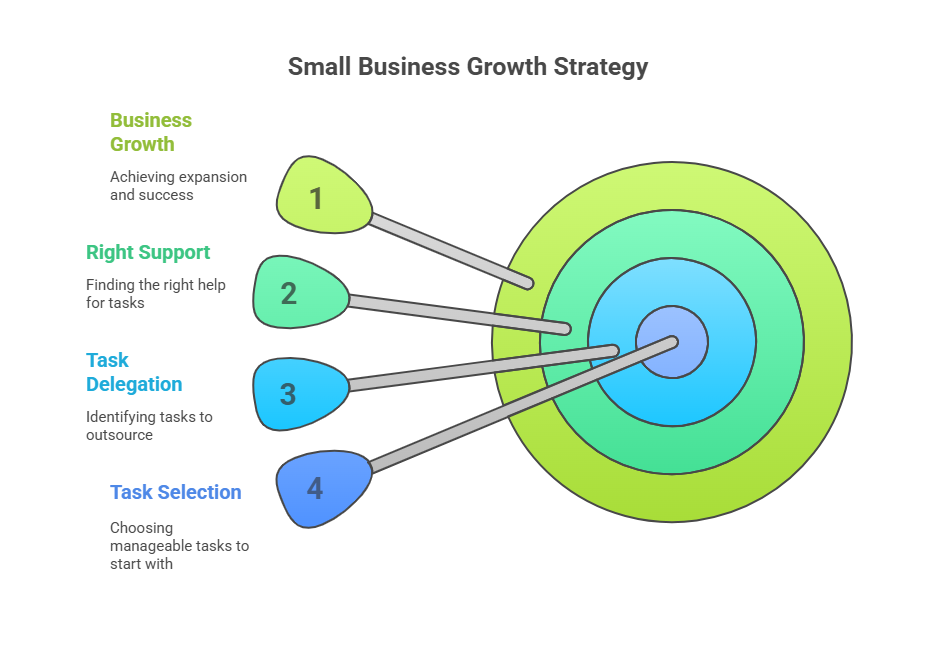
You don’t need a massive team to grow. You just need the right help, at the right time, doing the right work.
“You’re going to be tempted to say things like ‘“’I like to roll up my sleeves’ or ‘“’I’m in founder mode’”’. Just don’t. Accept that you are struggling to delegate and be transparent about that. Build the muscle of trusting your team to do what you hired them to do.” – Adrienne Kmetz of AK Consulting
If you read this far in the article, you’re interested in finding help that will allow you to grow your business. My challenge to you is to find one task or type of work that someone else can do and find a resource. If this is anxiety inducing, start with a task that small enough that won’t cause you sleepless nights if it goes wrong. Learn from it and then continue to find tasks that you can take off your plate.