If you’re writing RFPs for the first time, or trying to improve your process, this guide is for you. If you love a good children’s story, even better!
For a good portion of my career I’ve been in a position where I need to respond to RFPs. These have ranged from playing a small role in large federal contracts to writing the whole RFP for elearning module development. With every RFP I find myself saying “why can’t they just…” over and over.
But why should this matter if you’re writing the RFP? That’s on the vendor, right?
Not quite. This is the beginning of your relationship with your vendor. It is also your chance to get it right and find the best fit for your project and your organization’s culture. The right fit is likely to improve the results of the project and save you time and money. Communicating clearly in your RFP gives you the best opportunity to start that relationship on the right foot and find the right partner.
Writing RFPs that attract and help you identify the right partners is a competitive advantage.
According to the Association of Proposal Management Professionals (APMP), 62% of members work more than 40 hours per week on proposals, and 45% have additional responsibilities beyond proposal writing. responsive.io
For years I’ve wanted to condense this down into some straightforward guidance that small organizations (and big if they’d like to improve) can use that will help them run a proposal process that leads to finding a vendor and price that is “just right”.
The Goldilocks Principle: Not Too Short, Not Too Long, Just Right

Goldilocks stumbles into a house and samples three bowls of porridge, three chairs, and three beds until she finds the one that’s “just right.” This is a big ask as you look at your RFP. Whether your bidding out a system or a service, the RFP is your opportunity to paint as accurate a picture as possible.
Again, I’m approaching this from someone reading RFPs and providing responses. Some RFPs ask you to lasso the moon but give you only two pages to respond. Others provide a laundry list of ideas that rival Bubba Gump’s list of meals you can make with shrimp. Neither approach gets the best results.
On average, a public sector RFP is 116 pages long, and the resulting proposal is 144 pages. responsive.io
A “just right” RFP clearly defines:
The scope of work
Even if you’re not sure how big the final product will be, give vendors something they can all respond to. Instead of saying “Design a course that teaches the basics of business development.” try saying “Design elearning modules that represent roughly 2 hours of seat time on the basics of business development. Content will include our proprietary process that is documented in SOWs and is in the heads of 2 amazing subject matter experts.”
Timeline
I know that organizations don’t like to give the budget. That’s ok. But you do need to give a clear sense of how much time the vendor has to do the work. Don’t ask for vendors to propose a timeline when you know that you need to show it at your annual conference in July.
Success metrics
A strong RFP doesn’t just describe the work; it defines success. Don’t make vendors guess what is important.
Success metrics tell vendors what you will care about when the project is over. Without them, it’s easy for both sides to misalign. Do you want flawless execution? Innovation? Something that moves the needle with your audience?
Here are a few examples of success metrics you might include:
- Engagement: “We want at least 85% of users to complete the training and rate it 4 out of 5 or higher.”
- Adoption: “The final system should be used by at least 100 staff within the first three months.”
- Time-bound outcomes: “We want to launch by July 1 to align with our conference.”
- Knowledge gains: “We’ll measure success based on pre/post quiz improvement or behavioral follow-up surveys.”
You don’t need to define every single outcome in numerical terms—but give vendors a sense of what you’ll be watching most closely. If it’s important enough to talk about in the post-mortem, it’s important enough to put in the RFP.
If you’re writing RFPs without defined success metrics, you’re leaving good vendors guessing.
Bonus tip: If you’re not sure what success looks like, say that. Ask the vendor how they define success on similar projects. That can turn into a great conversation during selection.
I am well aware of how hard this is in practice. What does “just right” look like? I’m going to cover some additional principles that will help you keep your RFP focused and respectful of the responder’s time but rich enough to spark meaningful responses.
Writing RFPs with Focus: Avoiding the Mad Tea Party
Alice attends a tea party hosted by the Mad Hatter and March Hare, where everyone talks in circles, changes seats constantly, and nothing makes much sense. I have responded to RFPs where I can almost track the evolution of the RFP as it went through internal reviews. This often starts with an RFP from a previous project and is added onto by each reviewer.
Our team regularly responds to RFPs for elearning development. Occasionally, I’ll see an RFP that requests mastery of Adobe Flash (RIP) or another ancient technology. It would make my year if I found an RFP that said we should be proficient in Authorware (my first elearning authoring experience).
When the RFP starts with a previous RFP and then everyone adds their own priorities and buzzwords the RFP is bound to become confusing and contradictory.
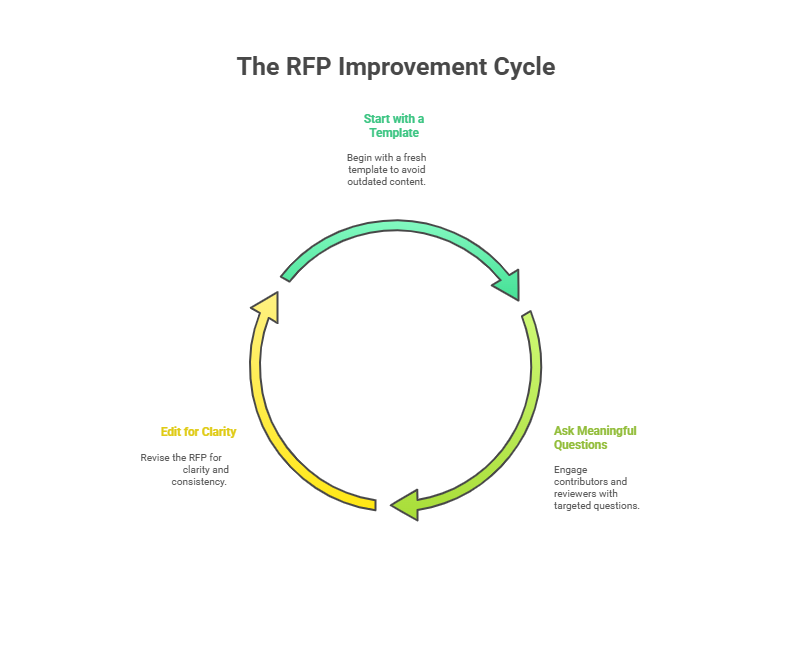
Some ways that you can avoid these traps when writing an RFP:
- Start with a template but not with a previous RFP. We all love shortcuts but this is one that we feel is just disastrous. There will be language in the RFP that looks right because it probably was and was probably written for a very good reason for another project. This is the easiest to miss. Because it was written down and looks logical, nobody questions it. Vendors then build their response around a requirement that doesn’t apply.
- Ask questions of contributors and reviewers that will get meaningful answers. For example, instead of asking someone to verify that we covered everything in the RFP, find a reviewer who can tell you what they read. Ask them “What do you think we’re looking for? How big a project does it seem like it is? What do you think we care about the most?
- Edit ruthlessly for clarity and consistency. I know what it feels like to want the RFP out the door but reading and re-reading it multiple times from the perspective of someone who doesn’t know your organization intimately will give you a better RFP.
Keep your tea party small and focused, and everyone will leave with their head still on straight.
Build Your RFP Out of Bricks
The Big Bad Wolf huffs and puffs and blows down the houses made of straw and sticks. Only the brick house stands firm.
Your timeline is tomorrow. Your budget is $500. Your expectations? Sky high. Sound familiar? Unrealistic RFPs scare away the strongest contenders and attract vendors who overpromise and underdeliver. You want to build an RFP that clearly outlines the work needed. Now, this doesn’t mean that you can’t leave room for creative solutions! That should be part of why you’re bidding it out. But you do want to be clear and realistic about what it is that you expect from a vendor.
Instead you can write your RFP and:
- Be transparent about your budget
- Allow reasonable timelines for both proposals and project completion
- Be clear about what trade-offs you’re willing to make
Build your project requirement out of bricks, not straw.
The Emperor’s New RFP: Clarity Over Cleverness
Two swindlers convince the emperor they’ve made him magnificent new clothes, so beautiful that only the wise can see them. No one dares admit they see nothing, until a child blurts out the truth.
Flashy language, dense jargon, and buzzword bingo may sound impressive, but they rarely communicate what you actually need. We see this on learning and development RFPs on a regular basis. Because they are looking for a firm with clear expertise in adult learning, they mention processes and principles galore.
I’m fully aware that I’m probably being overly clever in writing this article, but it is much less effective when an RFP is meant to be the beginning of a working relationship.
We once responded to a proposal that was a great fit for our company. We had to do a little bit of acrobatics to make our process match up with what they had described as their process. Once we were on the phone with them we learned that they didn’t really care about that process but it is what they had done four years earlier when they built elearning modules. These were really smart and talented people. They didn’t need to add this to the RFP to show they were smart.
Resist the urge to write RFPs like a Fortune 500:
- Use plain language. When you write your RFP it shouldn’t be radically different than how you would explain the project to your boss, your colleagues or even (gasp!) your spouse. Test yourself by explaining it. Now, use those words.
- Ask what you really want to know. Don’t ask for examples of …
Vendors can’t deliver what they don’t understand.
Cinderella’s Clock Is Ticking: Give People Time to Say Yes
Story: Cinderella
Cinderella gets her magical moment at the ball but only until midnight. When the clock strikes twelve, everything falls apart.
Some of the best vendors might be working with other clients or juggling deadlines. If you want a thoughtful proposal, give them time.
Consider:
- A minimum 2-week response period (3 is better)
- Including key dates like interviews, selection timelines, and project kickoff
A little extra time can make the difference between “meh” and magic.
Building the Right Team: Know Who You’re Looking For

Whether you’re a fan of Wicked, The Wiz, or prefer the original Wizard of Oz, Dorothy always struggles until she finds the right team, the Scarecrow, Tinman and Lion. Each one believes they’re missing something that makes them valuable, but as they travel together they discover the strengths they possess.
Just like Dorothy assembles a unique team with a blend of intellect, emotion, and bravery, your RFP should reflect the kind of collaborator you’re truly seeking. We often see small organizations distributing RFPs that ask for the Wizard, I mean, a solo contractor. They want someone who can do everything. That is rarely realistic. Be open to hiring a team when you need a mix of skillsets.
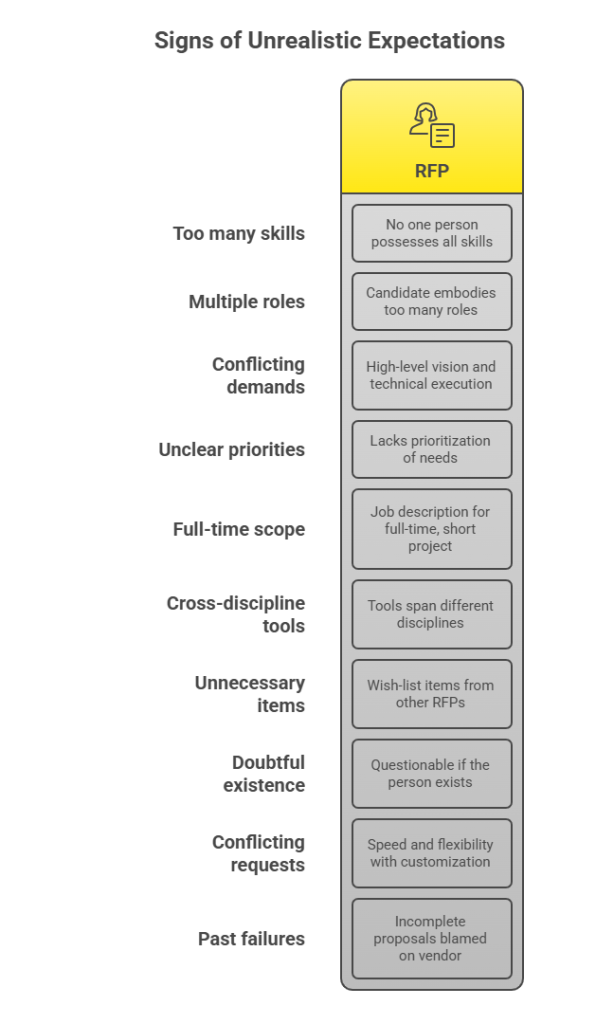
You’ll know you’re asking for a Wizard instead of a Dorothy, the Scarecrow, the Tinman and the Lion because:
- You’ve listed five or more distinct skill sets and you can’t actually think of a single person who does all of them well.
- Your dream candidate sounds like three people in a trench coat: a designer, developer, strategist, project manager, and facilitator all rolled into one.
- You’re asking for both high-level vision and deep technical execution and expecting it from one contractor.
- You describe needing “strategic guidance,” “hands-on production,” “rapid turnaround,” and “long-term support” without prioritizing which one matters most.
- You feel like you’re writing a job description for a full-time hire, but the scope is for a 3-month project.
- Your “must-have” list includes tools and technologies across different disciplines, like Adobe Illustrator, Articulate Storyline, Salesforce, and instructional design models.
- You’ve included wish-list items just because you saw them in someone else’s RFP, even if they don’t apply to your project.
- You find yourself thinking, “I don’t know if this person exists, but we’ll see what we get.”
- You’ve asked for both speed and flexibility—but also request customized deliverables, multiple rounds of revision, and lots of stakeholder input, which require time and collaboration.
- You’ve received proposals in the past that were incomplete or noncommittal, and you blamed the vendor, but now realize your RFP might not have been realistic.
Instead, build your RFP like Dorothy built her team. Ask yourself:
“Do I need someone with brains, heart, courage or do I need an agency that brings a team who can make the trip down the yellow brick road together?”
Leave Breadcrumbs: Help Vendors Understand You
Lost in the forest, Hansel leaves a trail of breadcrumbs to find his way back, but the birds eat them, and the siblings get lost. Ok. I had an idea here and it is getting lost. I think your best RFP is one that leaves more than a trail of breadcrumbs. We want signs! We want to compete on apples to apples. When we can’t find our way to the right answer and have to guess about intentions, you won’t get a great response. The best proposals are tailored. To make that possible, give vendors a sense of who you are.
Your RFP could include:
- Links to strategic plans or annual reports
- Context for why this project matters now
- A snapshot of your organizational culture
Write your RFP to help good-fit partners find their way to your door.
Happily Ever After: Final Tips for Writing RFPs That Get Better Results
Writing an effective RFP is like a good story, it’s clear, compelling, and has a purpose. With the right structure and a bit of heart, you’ll attract partners who truly understand your needs and can help you write your next success story. So go ahead. Set the table. Choose the chair that’s just right and invite the right folks in to help you build something that lasts.