If you treat running a small business the same as running a large business, then you are doing yourself a disservice.
When you run a small business, you’re not just leading a company, you’re often the strategy team, the operations manager, the sales rep, and the person ordering branded merch. And yet, so much of the advice out there is aimed at startups chasing venture capital or large companies with departments and layers.
Here’s the truth; running a small business is different, and that difference affects everything you do. It affects how you grow, how you manage your time, and how you define success.
I’m not suggesting that there isn’t value in learning from all businesses. I’ll point you to people like Peter Drucker who was mostly working with executives at large corporations, but I will also strongly encourage you to get your tactics from authors like Donald Miller in his book Marketing Made Simple.
You can check out other books that influenced us on our small business journey in the small business bookshop.
What can Tim Waxenfelter tell me about running a small business?
That’s a great question! With the rise of AI for producing content you should always ask yourself who you’re reading. I spent 7 years in a large education company working on government contracts. I left to join a wonderful little company where I was the 28th employee when I started and the founder was running the company.
When I left 10 years later the company was a leader in the market (I’m not claiming responsibility) and I had launched a major online product, our first Iphone app, and had helped grow our footprint in the K-12 digital space.
Since 2015 I’ve been the COO of Endurance Learning. When we started it was really just me and my partner Brian Washburn who was still working his full time job. We’ve experienced major ups and downs in that time, but we have always been an organization that learns and tries to get better at its work.
Today, we have a team of people supporting dozens of clients at any one time from Fortune 500s to global NGOs.
Running a small business means wearing every hat (until you can’t)
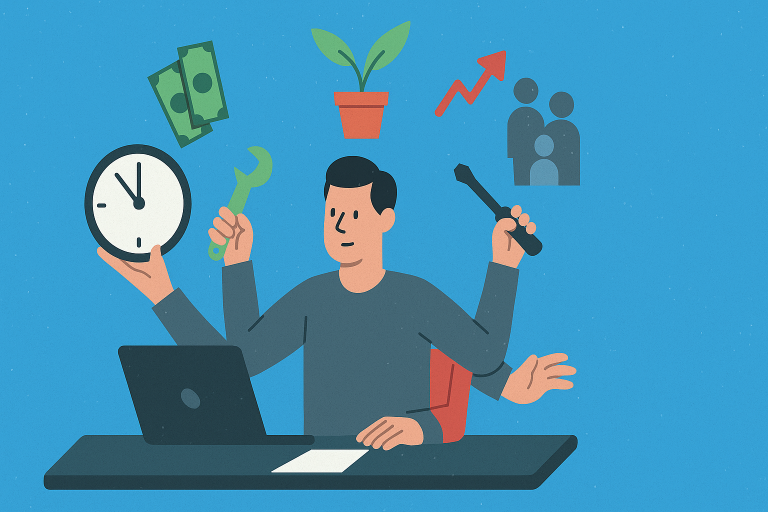
In a big company, roles are specialized. In a small business, they’re stacked. You won’t get the title, the pay, the chance to deepen your skillset, or the time to do the work. Does this sound familiar? It should. It is a near universal situation with small businesses. You might start your day writing proposals, switch to handling a client issue, and end it catching up on bookkeeping.
According to Qatalog and Cornell University’s 2021 Workgeist Report, “Context switching causes a lack of cognitive function. Human brains are not wired for a working day of glancing between your inbox, various different documents, slide decks, and more. No wonder that about 6 in 10 people say this makes them less productive and say it is very tiring to switch between tools and communications channels all the time.”
There’s no IT team, HR team, or finance department—you’re it.

This juggling act isn’t a flaw of running a small business. It’s a feature. It forces creativity, adaptability, and fast decision-making. But it also means your time and energy are finite resources.
Eventually, growth comes not from doing more, but from doing less personally. Learning to delegate—even when no one else will do it “just right”—is a rite of passage for any small business owner who looks to grow their business.
Pro Tip 1: Start by offloading low-value but time-consuming tasks (scheduling, invoicing, email follow-ups) to freelancers or automation tools.
Pro Tip 2: Use a Business Plan Writer to build your pitch deck and business plan. You don’t have to go it alone!
Your time feels different because you own the business.

If you’re like me (old) your first job involved clocking in on a time clock. It worked in 15 minute increments. One summer I worked a job where I had to clock out for lunch. I wasn’t very much into self-care so my lunch involved walking across the street to the half smoke cart (a DC staple at the time) and at got a half smoke with chili and cheese (known then among my friends as meat on meat with cheese) and a coke.
My entire lunch cost me $5. This was good for my budget though I probably would have benefited from some sandwiched made at home.
I would eat my lunch (what I thought at the time was slowly) and return to work. I would often get back before the clock had moved to the next 15-minute increment. I had to wait for it to click forward so I clock back in. I was delighted! I only lost 15 minutes of unpaid time!
Even in salaried jobs where I spent most of my career, I still cared about whether I was putting in my time. This was mainly because others did and questioned people for not working enough.
Thirty years later and my perspective on time has completely changed. Because I own my own business I can’t worry about whether my time is on the clock. I have to ask myself whether I spent that 15 minutes doing work that would grow my business. In a corporate job, hours are tracked and roles are scoped. In a small business, your time is deeply tied to value.
“There may be interruptions that are allowed that are not functional or valuable, but managing those is just tactical to your definition of your job. It’s an eternal challenge of allocating limited resources (management)—it’s not an inherent problem.” The Getting Things Done blog.
20 years ago I was leading a team where several members were struggling with productivity. I walked down the street to Barnes and Noble (yep, it was 20 years ago) and found the book Getting Things Done by David Allen. I loved the simplicity of his views on work and focus.
You can check out all of the books we recommend in Small Business Books.
Allen offers a powerful framework for small business owners who often find themselves overwhelmed by competing priorities and constant context switching. One of the core ideas in GTD (Getting Things Done) is the importance of mental clarity. Small business owners typically keep a range of important needs and tasks in their heads. GTD encourages capturing everything in an external system (a notebook, task manager, or app) so the brain is freed up for thinking, not remembering. This reduces mental fatigue and creates more space for strategic thought.
What’s critical is that Allen reframes time not just as a resource to manage, but as something to direct with intention. For small business owners, that means fewer dropped balls, more control over the day, and ultimately, more energy for the work that matters most.
In the era of email, Slack chats, Teams calls, meetings, and old-fashioned phone calls, you can easily go a whole day or week without ever addressing your to do list. If that happens, you are choosing to tread water instead of grow your business.
Running a small business means losing an average of 96 minutes of productivity daily, which amounts to three weeks of lost time per year. – Slack via Salesforce
While I agree that we lose productivity daily, my guess is that Slack wants you to believe technology helps and you know that it can also do the most damage to your workday.
As a small business owner you must protect their calendars with the same intensity that a CFO protects cash flow. Your time is valuable and should be spent doing work that is helping the business grow.
As “CFO” you think about money differently.
When we first launched Endurance Learning, my decision making hierarchy for purchases was simple. If I could do it without paying, I would. We weren’t bringing in much money yet and every dollar was sacred. I would only pay if needed. When we needed an accounting system, I knew we had to pay for a tool. I had several criteria but price was at the top of the list.
Once we had more consistent revenue streams I had to break my habit of looking for free or cheap and making up the difference with my own labor. My time was more needed to help grow the business. I had to consider the value that each purchase brought to the company and what I could do with the time saved.
“Data shows that 38% of businesses fail due to exhausting their cash reserves or the inability to secure additional capital.” Forbes
When you are a small business, every expense matters because the money is yours. But that doesn’t mean it is as easy as balancing your checkbook (I know, I know. That’s not a thing anymore). Most small businesses operate in a very basic way. When the bank account balance is high it is time to pay yourself or to invest in the business. This rarely accounts for what cash flow will look like in the coming months.
“The first step in solving your cash flow problem is to determine what’s causing it.” – Janet Attard
Thinking about money in a business requires some changes even for the most conscientious. How many of us would think to run a credit check on a new customer? That’s a tactic that Attard recommends. I certainly wouldn’t but I can point to a few situations in my 10 years of running a business where that may have been helpful.
How you spend your money also changes. When you hire someone to do a job, you have to consider what you can do with the time you save or whether you can create something higher quality by outsourcing to a specialist.
Similar questions will come up when you invest in software. If you are going to spend money on a CRM, you should really think about how much value you’ll get out of it. Don’t get drawn in by features. If you listen to HubSpot ads on your favorite podcast you’ll believe that you’re going to be amazing at marketing because you pay for their tools. Is that true? You might consider using Google Sheets until you learn what works and need to grow.
When running a small business, financial decisions aren’t just numbers on a spreadsheet; they’re choices that shape your work-life balance, stress levels, and long-term sustainability.
Try This: Use a “profit-first” model to ensure you pay yourself and build reserves, even if it means raising your prices or tightening scope.
Advice for Big Companies and “Startups” Doesn’t Always Apply to Running Small Businesses
When we first talked about starting a business I began consuming every source of startup content I could. I listened to a lot of podcasts (in the early days of podcasts) and read everything I could get my hands on. I loved books like The Lean Startup by Eric Ries and ate up everything I could from Y Combinator.
Then I realized that while these were all really fascinating, they weren’t the issues I was facing in my business or the decisions I could make. I definitely learned from them but I hit a point where I needed to hear from people who were growing true small businesses and were thin on resources.

I also realized that many sources of information for small businesses focus on an individual running a local business like cupcake business (seriously, that feels like the most common example). That wasn’t us either. But what it proved to me is that I needed to seek out resources that would speak to me.
I saw the same thing in the software that is sold. While the market appears to be changing, there will always be more money available from big companies. Few software providers will want to stay in a market focused on small businesses because selling to a 1000 person company is always perceived as easier and more profitable than selling to 100 10-person companies.
Even seemingly universal advice like “hire the right team” often misses the mark. It assumes you have the luxury of hiring at all, let alone the budget to carefully curate a bench of specialists. In contrast, small business success tends to hinge on very different principles.
Instead of chasing broad reach, small businesses often thrive by cultivating deep relationships. Rather than building long-term product roadmaps optimized for investors, they benefit from scrappy, iterative development that solves real problems fast. And instead of implementing a sprawling tech stack from day one, they create custom-fit systems that solve today’s needs and leave room to evolve (See our Small Business Software Selection tool).
If the advice you’re hearing assumes departments, burn rates, or 10-person teams—it may not be built for you. Look for voices and strategies that reflect the true shape of your business: lean, adaptive, and built from the ground up.
If it sounds like advice for a boardroom or a 10-person department, it might not be for you. Look for strategies built for businesses under $5M or teams under 10. Find mentors or content creators who are in the trenches of small business ownership, not just entrepreneurship influencers.
Success Isn’t Always About Scaling
Many small business owners didn’t start their businesses with dreams of rapid scaling or chasing unicorn status. Instead, they launched their ventures to build freedom into their lives, to do work that felt meaningful, to replace a job with something more fulfilling, or to create financial and lifestyle stability for their families. While growth can be important, it shouldn’t be pursued blindly. Scaling without a clear purpose can lead to unnecessary complexity, increased stress, and heightened risk.
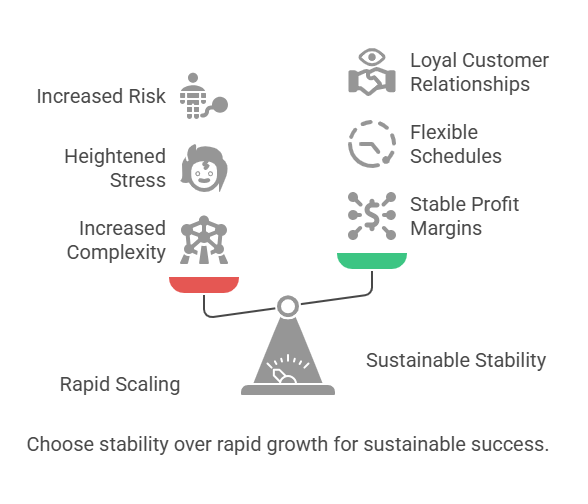
While running a small business I have seen this reality with staff costs. Over the first ten years of our business we’ve had several times of big growth. With each time of growth we added staff. This worked extremely well during those times, but became a huge risk when we had a few slow months. Because we sell to businesses (B2B) and our work is on a slow sales cycle and requires that we have trusted relationships with prospects, we can’t pull levers to dramatically increase sales in a particular month. The payroll costs don’t go away during this time and savings can quickly disappear (Check out our guidance on ways to scale your small business through outsourcing).
For many small business owners, success isn’t and shouldn’t be measured by headcount or market share. It’s about creating stable profit margins, maintaining flexible schedules, building relationships with loyal customers, and keeping overhead low. These quieter forms of success may not make headlines, but they are deeply rewarding and often far more sustainable.
Just because you can grow doesn’t mean you should. Success is personal. Define yours clearly, or someone else will do it for you.
Never Stop Learning
Unlike a large corporation with specialized departments, the small business founder is, by necessity, a generalist who must constantly adapt to new challenges; from mastering social media trends to optimizing their website’s performance. The expectation is that you are the CEO, CFO, Head of Marketing, and IT Specialist all at once. This multi-faceted role makes a continuous learning mindset the single most critical skill for long-term survival.
You can’t afford to hire an expert in every domain, so you must become proficient in core areas that drive your business. For instance:
- Financial Literacy: You need to understand your cash flow and how to report taxes. This is where tools like Xero or FreshBooks (both under our Financial affiliate product type ) become indispensable. Understanding the basics of accounting isn’t optional; it directly impacts your bottom line.
- Operations & Automation: You can’t spend all day on manual tasks. Learning to use automation platforms like Pipedream or Make allows you to connect disparate services, streamlining your workflow and freeing you up for higher-value work. Our article on how we built a lead generation workflow with automation will help you get started.
- Digital Presence & SEO: If customers can’t find you, you don’t have a business. You need to learn the basics of search engine optimization (SEO) and use tools like Semrush or Rank Math to ensure your website is visible.
You don’t have the be the expert in everything to run a small business,but you have to know what questions to ask. To thrive while running a small business you must actively cultivate a thirst for knowledge and make learning a non-negotiable part of your weekly routine. This commitment ensures you’re always equipped to make informed decisions and stay ahead of the competition. Developing a continuous learning mindset is essential to bridging the knowledge gaps you will inevitably face as a founder