AI has become a powerful tool for small businesses, helping automate tasks that used to require significant time and expertise. Small businesses can also excel by using AI in products and services. And they can do so without breaking the bank.
40% of small businesses self-identified they use generative AI—nearly double the level from last year (23% in 2023). – US Chamber of Commerce
In this article, we will explore how our team at Endurance Learning integrated AI into our product, Soapbox, to make high-quality instructional design faster, easier, and more accessible for small businesses.
I had the opportunity to speak with Graham Roberts of Full Stack Consulting who runs the SME Growth Cohort. Watch the video below to hear the full conversation about how Soapbox +AI came to life and how small businesses can approach AI without needing a development team.
The Problem with Traditional Training Design
Training development has long been a manual, hands-on process. At Endurance Learning, we help organizations turn subject matter expertise into effective classroom and virtual training. But even with an experienced team, designing quality training is labor-intensive. Every session requires careful crafting of learning objectives, activities, slides, and facilitator guides.
There are other great instructional designers out there and great teams like ours. The challenge is that there is way more training than can be developed by experienced teams. This means that much of what gets developed is created by well-intentioned and incredibly smart SMEs (subject matter experts) who have built up expertise in their field but don’t have the background to create great training.
We estimate (unscientifically) that 90 to 95 percent of the training we see at conferences or inside organizations is poorly designed. The reality is that most people responsible for training are not instructional designers. They are subject matter experts trying to do their best without formal design skills.
For small businesses, this creates a huge barrier. Hiring a professional instructional designer may be out of reach. And DIY training often misses the mark.
The Origin of Soapbox
Soapbox was created to solve this problem. Our goal was to help anyone, not just instructional designers, create better training faster.
The original version of Soapbox worked by asking users for basic details about their session. The topic, the length, the audience size, and the delivery method.
From that input, Soapbox generated a structured lesson plan, a facilitator guide, and slide templates. It gave users a proven framework based on instructional design best practices. But there was still one major limitation. Content.
While Soapbox could generate the structure of a good training session, the user still had to write the content for slides, write detailed facilitator notes, and build the details of each activity. It was a huge time-saver, but it stopped short of being a full solution.
Where AI in Products Comes In
Like many small businesses, we started to ask if AI could fill in the content gaps.
When we first built Soapbox, large language models like ChatGPT did not exist. But with the rise of AI tools, the opportunity to solve this long-standing problem finally appeared.
Soapbox +AI is the next evolution. It combines the trusted instructional design framework of the original Soapbox with the power of AI to generate customized content.
Now, instead of handing users a blank template with placeholders, Soapbox +AI can generate the actual content for slides, facilitator notes, and activity instructions. All tailored to the specific training topic.
Building with Guardrails when Using AI in Products
Using AI in products should not be taken lightly. If you follow a subreddit like r/vibecoding or r/microsaas you’ll see that there developers are building and launching new products daily. If you’re reading this article, you are probably more like Endurance Learning. You have an audience that trusts you and your reputation takes a hit whenever you miss the mark. Thus, adding AI in products or services you deliver should be done carefully.
“Being open, honest, and transparent in your use of AI is essential to gaining and retaining your audience’s trust.” – Understanding the Tools, Benefits, and Ethical Considerations of AI Content Creation
Our approach to using AI in Soapbox, a product that supports professional training design, is to tread lightly and build guardrails. Trust is a core part of our business. Our clients rely on us to deliver training that meets high standards for adult learning.
That is why Soapbox +AI does not simply hand everything over to an AI model and hope for the best. Instead, it uses AI within strict guardrails. The AI generates content based on the proven structures we have developed over the years.
For example, every training session still follows clear instructional patterns. Opening activities, content delivery, application exercises, and closing discussions. AI fills in the details, but always within those boundaries.
How Soapbox +AI Works
The process in Soapbox +AI starts the same way it always has, with a few key inputs.
- What is your training topic?
- How long is the session?
- How many participants?
- Is it in-person or virtual?
From there, Soapbox +AI generates learning objectives based on the topic. The objectives are created using pre-defined action starters like Develop a plan to or Identify the root cause of. This keeps objectives clear, actionable, and aligned with adult learning principles.
Once the objectives are confirmed, Soapbox generates a detailed lesson plan, a facilitator guide with speaking notes, and slide content. This includes key points, visuals, and prompts.
Behind the scenes, AI is working in small, controlled steps. Instead of sending one big request and hoping for a good answer, Soapbox uses multiple smaller AI calls to improve accuracy and consistency. It builds the content step-by-step, ensuring the output matches the instructional design framework.
How to Test AI in Products and Services for Free (or Cheap)
You do not need to be a programmer to test AI in products or services. Nor do you have to invest heavily to start testing whether AI can improve your product or business.
When we started exploring how AI in product development could help us generate training content, we did not build it directly into Soapbox. Instead, we hacked together a prototype using tools we already knew.
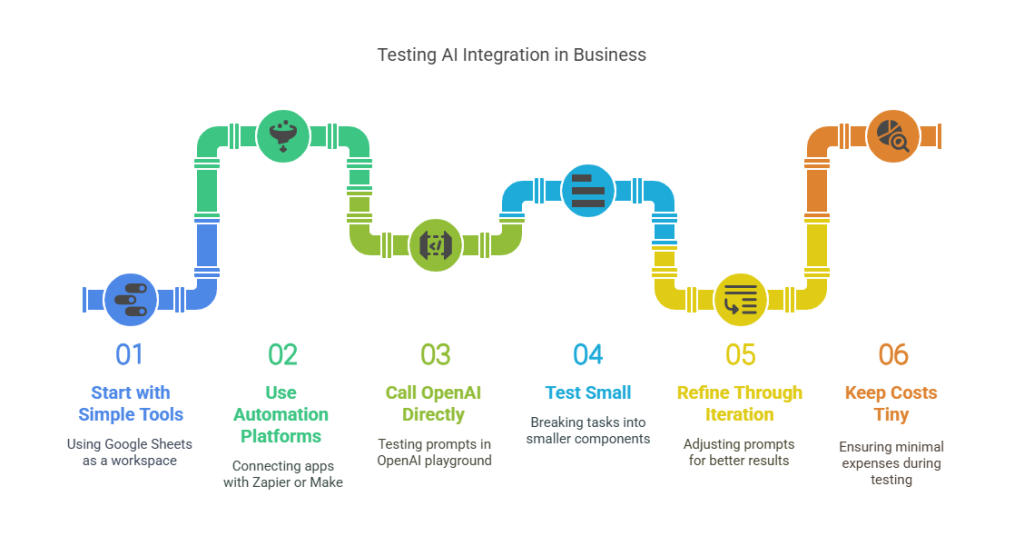
Here is how we tested the idea before writing a single line of code.
- Start with simple tools. We used Google Sheets as our workspace. Each row represented an activity, a slide, or a piece of content we wanted to generate.
- Use Zapier, Make, or Pipedream for automation. These no-code platforms connect apps together. We set up a simple automation where filling in a row in Google Sheets would trigger a call to OpenAI.
- Call OpenAI directly. The OpenAI playground and API are surprisingly accessible. You can test prompts directly in the playground or connect via Zapier to automate the process.
- Test small. Instead of asking AI to generate an entire training program in one step, we broke it into smaller tasks. One call for learning objectives. Another for slide content. Another for activity instructions.
- Refine through iteration. Every time the AI gave us an odd or inaccurate result, we adjusted the prompt. We learned quickly that the more specific we were, the better the output.
- Keep costs tiny. During testing, each call to OpenAI cost a fraction of a cent. We ran dozens, maybe hundreds, of tests before we even spent ten dollars.
This approach let us answer the most important question first. Can AI generate output that meets our standards and that customers would trust? Once we proved that, we had the confidence to invest in building AI directly into Soapbox.
The takeaway for any small business is that you do not have to start with a full-fledged AI product. You can validate the idea with simple tools, low costs, and no coding required.
Balancing Speed, Accuracy, and Trust
There is always a tension when using AI between speed, automation, and trust. For us, the answer was not to fully automate the process without oversight.
Instead, Soapbox +AI is designed to help users move faster while still maintaining full control.
The AI writes the content, but within instructional design best practices.
Users can edit, reorder, and customize anything the AI generates. The result is faster training creation without sacrificing quality.
What This Means for Small Businesses
AI is no longer something that is only accessible to big companies with dedicated engineering teams. Soapbox +AI is proof that small businesses can leverage AI to solve real-world problems with creating an AI product, per se.
For small businesses and teams who need to create training but do not have instructional design experts, AI changes the game.
Instead of spending weeks creating slides and lesson plans, you can now generate a full training session, structured, designed, and content-rich, in minutes.
Conclusion: Small Business Can Use AI in Products & Services
AI is here to stay and it is your opportunity to compete as a small business.
For us it was clear that AI is not replacing the need for good instructional design. What it is doing is making great training design accessible to more people. For small businesses, that is a huge win.
By combining the expertise built into Soapbox with the power of AI, we have created a tool that lets anyone create training that is faster, better, and more effective, without needing to be an instructional designer.
Ready to See It in Action?
If you are curious how Soapbox +AI can speed up your training design process, check it out at soapboxify.com and explore how AI is helping small businesses build better learning experiences.